
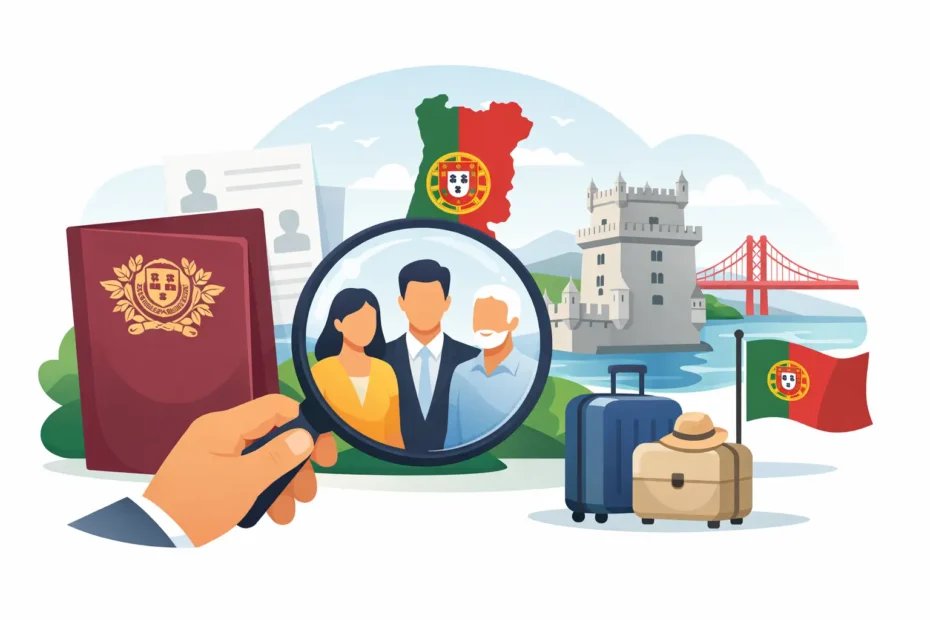
If your plan for Portugal goes beyond residency and into long-term security, portuguese nationality is usually the real milestone. It affects how freely you can live and work across the European Union, what status your children may inherit, and how stable your future in Portugal can become. For families, investors, retirees, and business owners, that distinction matters more than many people realize at the start.
A lot of people begin with the wrong question. They ask, “Can I get a passport?” when the better question is, “On what legal basis could I qualify, and what should I be doing now to protect that path?” Nationality is not a one-size-fits-all process. It depends on your personal history, your family ties, your residency record, and how well your case has been prepared from the beginning.
What portuguese nationality actually means
Portuguese nationality is citizenship. That sounds obvious, but in practice many applicants confuse it with residence permits, permanent residence, or tax status. These are different legal realities.
A residence permit allows you to live in Portugal under certain conditions. Permanent residence gives you more stability, but it still does not make you a Portuguese citizen. Nationality is the status that places you fully within the Portuguese state as a citizen, with the right to a Portuguese passport and the broader rights attached to citizenship.
That difference becomes especially relevant for people building a life plan, not just solving a short-term immigration issue. If your goal is family protection, business continuity in Europe, or a stronger long-term legal position, citizenship usually carries much more weight than a residence card.
The main pathways to portuguese nationality
There is no single route that fits everyone. The best path depends on whether your connection to Portugal comes through family, residence, marriage, or historical lineage.
Nationality by descent
This is often the strongest route when available. If you have a Portuguese parent or, in some situations, a Portuguese grandparent, you may be able to claim nationality based on that family connection. The strength of these applications usually depends on documentary proof, registry consistency, and whether the line of transmission can be clearly established.
For many families in Brazil and other Portuguese-speaking countries, this is where the process starts. Old civil records, name variations, missing registrations, and inconsistencies between countries can all complicate what seems simple on paper. A case that looks straightforward can slow down if records do not match exactly.
Nationality through marriage or a de facto union
Marriage to a Portuguese citizen can create a path to nationality, but it is not automatic. The legal relationship must be validly documented, and the authorities may assess whether there is an effective connection to the Portuguese community, depending on the case and circumstances.
This is one of the areas where assumptions can create problems. People often believe that marrying a Portuguese citizen immediately solves everything. It does not. Timing, supporting documents, and the factual context of the relationship all matter.
Nationality through legal residence
For many international clients, this is the most relevant route. If you have been legally resident in Portugal for the required period under the law, you may become eligible to apply for nationality.
This is particularly important for people entering Portugal through structured immigration solutions such as entrepreneurial, passive income, investment, or other residence pathways. In these cases, your nationality strategy should begin long before you become eligible to file. The quality of your residency history, renewals, compliance, and documentation can directly affect the citizenship stage later.
Other specific routes
Some applicants may qualify through Sephardic ancestry, adoption, or birth in Portugal under specific legal conditions. These categories are more technical and can change with legal updates, which is why individualized analysis matters.
Who usually has the clearest case
In practical terms, the clearest portuguese nationality cases are usually those where the legal basis is obvious and the documents are clean. A person with a Portuguese parent and complete civil records is often in a strong position. A legal resident with a consistent immigration history and properly maintained documentation may also have a solid route.
The more fragmented the paper trail, the more strategic the process becomes. This does not mean the case is weak. It means preparation becomes decisive.
For example, an entrepreneur living in Portugal through a business visa may be fully on track for a future nationality application, but only if company formation, tax records, renewals, address registration, and civil documents are all being handled correctly. The same applies to retirees, remote-income applicants, and families relocating with children. Citizenship planning starts much earlier than the filing date.
Common mistakes that delay portuguese nationality
The biggest problems are rarely dramatic. Most are administrative and preventable.
One common mistake is assuming residency alone is enough without reviewing whether the legal residence period has been properly documented. Another is overlooking inconsistencies in birth or marriage certificates, especially when records come from multiple jurisdictions. A third is waiting until the last minute to gather documents that may take months to obtain, correct, legalize, or register.
Language requirements can also become a hurdle depending on the route. Some applicants are surprised to learn that proving ties or meeting formal requirements may involve more than simply living in Portugal for a number of years.
Then there is the issue of strategy. People often treat residency, tax setup, family reunification, and nationality as separate tasks. In reality, they are connected. A poor decision early in the immigration process can make a later citizenship application slower, more expensive, or harder to defend.
Why timing matters more than most applicants think
Portuguese nationality is not only about eligibility. It is also about timing, sequence, and legal predictability.
If you are still outside Portugal, the way you enter matters. The visa or residence route you choose can influence the structure of your future path. If you are already in Portugal, your renewals, registrations, and family records should be reviewed with the citizenship objective in mind. If you are applying through ancestry, it may be worth resolving civil registry issues before taking other steps.
The clients who experience the least friction are usually the ones who plan backward from the final objective. They do not just ask how to move to Portugal. They ask how to move in a way that preserves future citizenship options for themselves and their family.
Portuguese nationality for families and business owners
For families, nationality is often about continuity. Parents want to know whether children can be included, whether future generations benefit, and whether the family gains a stronger legal position in Europe. These are not abstract concerns. They influence schooling, mobility, inheritance planning, and long-term residence security.
For business owners and investors, citizenship may support a broader international strategy. It can strengthen personal mobility, simplify certain cross-border decisions, and reduce dependence on temporary immigration statuses. But this does not mean everyone should rush into the same route. Sometimes the right move is to first build a compliant residence path, then prepare for nationality at the right moment.
This is where integrated planning makes a real difference. When legal immigration steps, tax structuring, business setup, and family relocation are handled in coordination, the nationality process later tends to be cleaner and more predictable. That is one reason many clients prefer a one-stop approach rather than managing separate providers with disconnected advice.
How to approach the process with fewer risks
The smartest way to approach portuguese nationality is to begin with case diagnosis, not paperwork. Before collecting documents, you need to know the legal basis of the application, the likely timeline, the evidence standard, and any weaknesses that should be corrected early.
From there, the work becomes much more practical. You organize civil records, confirm registry consistency, evaluate residence history where relevant, and prepare the file according to the route that actually fits your profile. If there are gaps, they should be solved before submission, not after the process is already delayed.
For many applicants, especially those balancing relocation, business activity, family planning, and cross-border assets, professional coordination is not a luxury. It is a way to avoid fragmented decisions. That is the value a group like Grupo Prisco brings to the table: not just filing support, but a structured path that connects immigration, settlement, and long-term legal goals.
Portuguese nationality can be one of the most valuable outcomes of your move to Portugal, but it rewards preparation more than improvisation. If your project involves family stability, market access, or a permanent base in Europe, the right time to think about citizenship is usually earlier than you expect.